
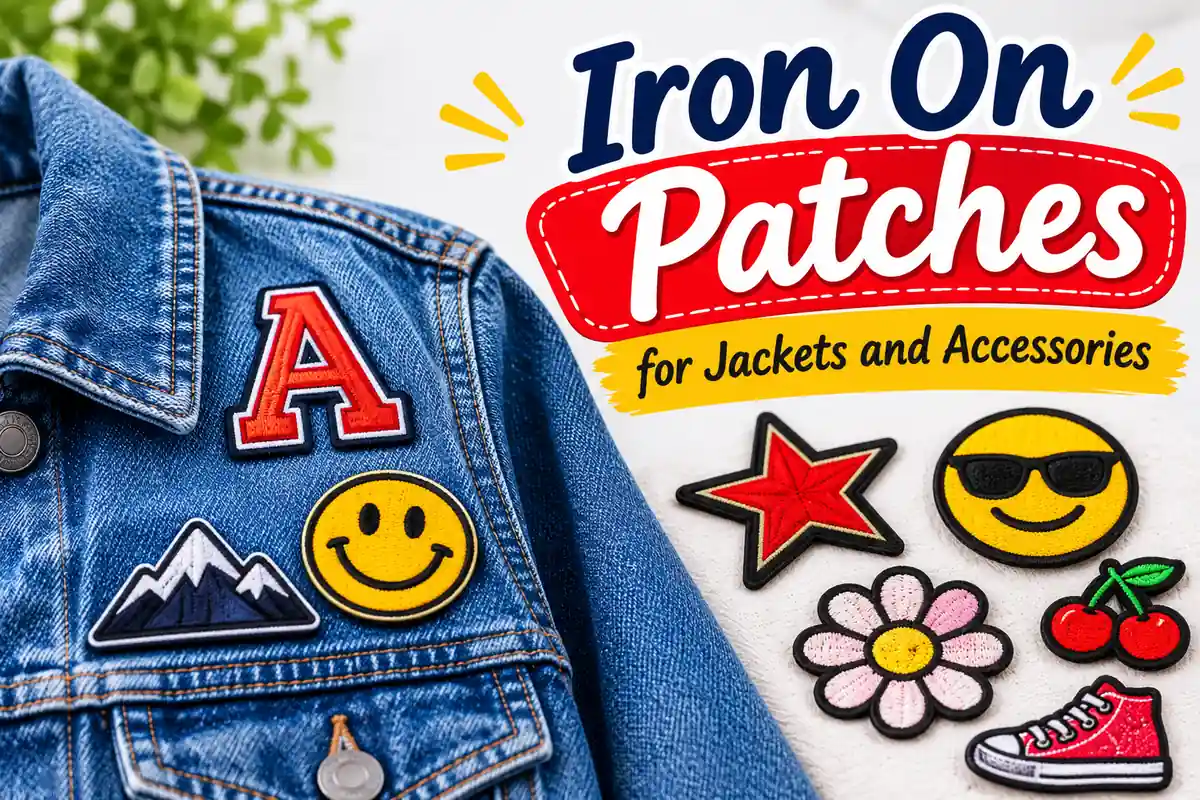
Iron On Patches for Jackets and Accessories
You own a jacket or bag that appears to be too simple and requires a little decoration without buying another one or purchasing anything else for the job. Patching might appear to be a solution, although picking the right patch and learning how to ensure that it stays in place through the iron on method could be challenging.
However, with some pre-planning, it is not all that hard. Let’s discuss how you can customise your jackets and accessories with different types of patches that look amazing and last long.
Why Customise Your Jackets and Accessories with Patches?
Your jacket could turn into an entirely new piece of clothing through just one design. Your backpack, denim purse or simple cap is no exception. Patches can be used to disguise a small stain or spot on the accessories. Before choosing a design, remember the following things:
- Style: Choose a design that will suit your attire.
- Fabric: Heavy materials such as denim and cotton are capable of handling heat compared to light materials.
- Placement: There are many places where the patch design can be placed, including on the sleeves, chest, pockets, and front of the backpack.
- Frequency: Keep in mind how frequently the item will be washed or folded.
If you wish to personalise your outfit with designs without having it appear cluttered, then Iron On Patches for Jackets would be a useful place to start. Sometimes one design will have more impact than multiple patches which have been randomly applied.
Which Accessories Can You Customise With Patches?

While most people think about jackets first, patches can actually be applied to other types of fabrics as well. It all depends on whether the type of fabric you use can withstand both the adhesive used for attaching the patches and the heat involved.
Jackets, Jeans, and Other Clothing Pieces
Jeans are especially ideal for creative patching thanks to their strong fabric that does not wear down easily under pressure. There are many places where you could attach patches, including the back, above the pocket or along the sleeve.
Bags, Caps, and Everyday Wear Accessories
With backpacks, bags, caps, and other fabric accessories, there is enough space for customisation. A little patch near the pocket of your bag will be subtle, while a big patch will make a focal point for your simple tote.
What Type of Patch Should You Choose?
Depending on the need and application of the design, you should choose the right type of design. Knowing different types of patches will help you to get the one that is appropriate for your jacket or accessory.
- Embroidery patches: The design has a raised effect due to stitching. Such patches are suitable for logos, initials and traditional jacket designs.
- Woven patches: These patches have fine thread that makes them appropriate for complicated artwork, small lettering and sharp lines.
- Printed patches: This type is good for colourful artwork, gradients and complicated details that are hard to recreate with thread.
- PVC patches: PVC patches are made from plastic material. Such patches are usually applied to outdoor wear and accessories. PVC patches do not need to be ironed at home. Therefore, learn how to apply the back of your patch.
Custom embroidered patches would be perfect for those who want their clothing to have a more classic look. In case of complicated text or logos, a woven patch could be better.
What to Choose Between Woven And Embroidered Patches?
Both types will allow personalising your clothing, but the outcome will be quite different. The selection of the patch type depends on the design.
| Feature | Woven Patches | Embroidered Patches |
| Appearance | Smooth, fine details | Raised, textured stitching |
| Small lettering | Usually clearer | May lose detail at small sizes |
| Bold designs | Good for precise outlines | Excellent for prominent artwork |
| Best use | Detailed logos and text | Classic jackets and decorative designs |
Comparison of Woven vs Embroidered Patches is a helpful step before the design process is finalised. The reason is that woven patches will be better for small letters, small lines and complicated symbols due to their more delicate design.
How to Apply Patches Correctly?
A great patch may become messy or peel off if you try to do this too quickly. If you follow the right procedure, you will have a better look at the end. If you are studying the procedure of how to make iron on patches or only applying a patch that has already been created, please read the instructions below:
- Test the material: See how your garment can be washed, as well as the care instructions for the patch itself.
- Prepare the material: If required, clean and dry the fabric as per the directions given on the label. It is essential that the surface of application must not have any wrinkles.
- Placement of the patch: Place the patch and check its positioning before heating it.
- Protect the design: If recommended by the care instructions, cover the patch with a proper pressing cloth.
- Apply heat and pressure: Use the recommended temperature and duration for that patch and material. Don’t move the iron on the patch unless specified by the care instructions.
- Verify the edge: Let it cool down as instructed and carefully check if the edges have adhered properly.
The temperature used and the pressing duration vary from one patch to another. For instance, as per the directions of Cricut, one should adhere to heat guidelines specific to the materials used and wait for the patch to cool down.
What Is a Patch Useful for When Refreshing Your Clothes?
Using a patch will help you get another life out of your old jacket or bag without buying a new one just because it is old-fashioned. You can also cover up some minor stains, brand your group clothes, or adorn your accessories.
Not all types of worn clothes can be repaired using patches, but patches will enable you to wear clothes that have good-quality fabric. For the creation of a harmonious look, you need to consider the following options:
- Attach one big design to the back of the denim jacket.
- Attach smaller matching patches to the sleeves and pockets of the clothes.
- Attach one contrast patch to the plain canvas tote.
- Try using several related icons instead of random art.
In case your art contains small lettering or intricate art details, custom woven patches can be very useful. They help to keep the logos and symbols in their original form.
Readers Usually Ask
Can iron be used for patches on any coat?
No. Denim and cotton material work well, but leather, waterproof materials, and some synthetic coats may get damaged by the iron.
Can iron on patches be washed without coming off?
Yes, if they are properly ironed onto the right type of material. You must wait until enough time has passed before washing, follow the directions on the package, and be careful not to use too much heat when washing and drying.
Are woven patches superior to embroidered patches?
Usually, woven patches are better suited for intricate details as well as tiny lettering. However, embroidered patches provide a 3D look. You should decide depending on the design and look that you need. When comparing Woven vs Embroidered Patches, you should think about the design details, material, and finish.
Can you sew a patch onto a bag?
Yes, provided that the fabric and the patch can be sewn safely. Sewing will provide a stronger bond, particularly on bags that experience a lot of friction and are used to carry heavy stuff.
In Conclusion!
In order to personalise either your jacket or your accessory, it is not required to purchase a new wardrobe. The right patch will help you add a new touch of individuality to your old favourite item, or simply make a design which will be unique for you. You will have to make sure that your fabric is compatible with the design and patch placement prior to ironing.
It is important to follow the instructions provided by the manufacturer regarding the temperature and the amount of time during which you should apply the iron to the material. In case you were wondering how to make custom iron on patches last longer, you will have to take into account all the points mentioned above.

I am Kelly James, and I enjoy helping people by providing them with clear and meaningful writing. I love creating content that is easy to read, informative, and engaging. Whether I am working on articles, blog posts, or website content, I always focus on making sure every piece connects with the reader. I am always learning, exploring new ideas, and finding better ways to tell stories that people enjoy reading.